Wireless Telemetry
Measure Things Without Being There
Wireless Telemetry lets you measure things at a distance, without having to be there, even if they're moving.
It can greatly reduce operational costs, lets you avoid unsafe places and enable you to get information almost as soon as it happens... from remote or difficult-to-access places, without having to go there to collect the data.
There's nothing like being able to look in on processes and
events, as they are happening, to give you the confidence that things
are OK, and to know that you could be alerted immediately if something
changes and then isn't OK anymore.
And wireless telemetry can save resources... for you personally, for the company you work for and the planet.
Think of the time and travel costs that you could save by replacing manual measurement with an automated electronic process that may mean that you wouldn't have to travel at all. This wireless technology can improve the efficiency of some processes by a staggering amount.
Why Wireless Telemetry?
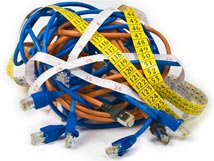
Forget the wires and measuring tape, wireless technology can do it better... without the mess. Imagine this...
You’ve been taking measurements in a remote place, over an hour’s drive away, and been manually transferring the data onto a computer at your workplace when you return. You prepare for the trip and the next day you drive there.
You arrive at the site. You download the data and drive back to work where you unload and transfer the data onto your computer. It’s taken two hours, but at least you don’t have to do it again… until next week.
And the week after that. In fact, every week. Maybe more often if a data download isn’t successful. More than a hundred hours every year. Time you could be doing something more productive. The cost…unnecessary expenses and 'a hundred hours' worth of lost opportunities!
Advantages of Wireless Telemetry
Wireless telemetry can help you sleep at night. It lets you...
- Greatly reduce operational costs
- Get real-time information
- Get data from things that move
- Easily get data into other systems
- Measure things in dangerous places
- Measure things that may be destroyed
- Know the measurements are actually happening
Here’s how...
Greatly reduce operational costs
Don’t waste time and money forever going to measure or download data. Getting data from remote or inaccessible locations comes at a cost, but wireless telemetry can greatly reduce this.
For example...
- If your vending machines had wireless telemetry they could automatically tell you when to restock.
Get now-time information
You don’t have to wait. You can see what’s happening, in real time, as it happens.
For example...
- Sports events, such as the America’s Cup yacht regatta, telemeter position, speed, wind conditions and other information to help generate the graphics that show race progress on TV, in near real time.
- Telemetering patients in a
hospital, or at home, can give early warning of serious changes in their
medical condition, allowing rapid response from medical staff.
Telemetry Nursing is a rapidly growing area of enhanced patient care. This type of monitoring allows patients to return home from hospital early… a win-win situation for everyone and especially helpful if the effects of medication have to be monitored closely.
Get data from things that move
Because most telemetry uses radio, it doesn’t matter if what you’re measuring is moving, as long as it stays within radio range.
For example...
- You can telemeter the critical parameters of racing cars or yachts during a race.
- Or the torque of a rapidly rotating turbine shaft.
- Or track animals.
- Or receive data about atmospheric conditions from a weather balloon.
Easily incorporate data into other systems
Being in electronic form, data can easily, and often automatically, be incorporated into other systems.
For example...
- Domestic electricity meters may be telemetered and the measured amount of electrical power used at each location automatically fed into a database, ready for billing.
Measure things in dangerous places
You can measure things in hostile environments, reducing the need to expose yourself to hazards.
For example...
- Volcanoes
Wireless telemetry of conditions at and around active volcanoes, measuring unrest indicators such as changes in earthquake activity, land deformation, or the discharge of heat and gas.
This is especially important for people living in countries that have emerged (geologically) from the collision of plate boundaries. Japan and New Zealand are two countries that live with this threat.
Geological threats tend to occur on a long timescale (tens or hundreds of years) so a large percentage of the world’s population hasn’t had first hand experience of one of these events. But they are real!
- Radioactivity Wireless telemetry can be used for monitoring areas that have dangerous levels of radioactivity. This may be routine monitoring around a nuclear power station. Or it may be a monitoring program put in place to monitor for accidental leakage of radioactive waste from a geological storage location.
- Toxic chemicals For measuring short-term spills or long-term leaching from landfills.
Measure things that may be destroyed
Wireless telemetry is a great way to get information during a test, when the thing you’re testing might end up being destroyed.
For example, destructive testing is often used to verify the limits of building materials or vehicles and information sent back, just before the point of destruction, provides valuable information for modifying the design.
Have confidence that the measurements are actually happening
Have you ever installed measuring gear at a remote site and the next day had doubts as to whether you’d set it up correctly?
You’re left thinking… should I go all the way back and check… or take the risk that on the next visit there’ll be no recorded data?
Wireless telemetry can give you the assurance you need, anytime, and allow you to check and verify that the data is of good quality… or even being recorded!
Are there any disadvantages?
Yes, but they’re not major and you can usually work around them. The advantages mostly, and usually significantly, outweigh the disadvantages, except in a few applications.
- You’ll require some equipment - an up front, but one-off cost... then your operational costs should drop significantly.
- You’ll need a wireless link that’s reliable. If you’re using radio, you need to establish that the receive end is in good radio contact with the transmitting end.
- It’s not always easy to supply power to the telemetry equipment at the measuring end, because it’s often remote... located away from a power source. But you can always use batteries if there’s nothing better.
A wireless telemetry system refers to the equipment you need to allow measurements to be taken from one place and transmitted to another place, where they’re needed. Here’s the big picture…
Wireless Telemetry Systems
The most basic wireless telemetry system has a…
- Measuring end, and a
- Receiving end
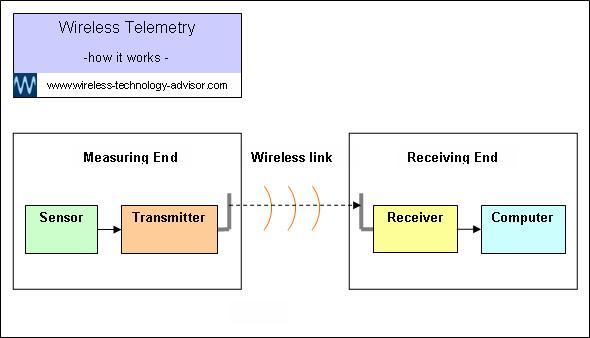
At the measuring end...
you commonly have two things...
- A sensor to sense the thing you want to measure, for example, water level
- A wireless transmitter to send the measurement data to the receiving end
The basic function is that of a wireless sensor.
However, you can connect one or more sensors to a data storage device, such as a data logger. The data is then transmitted from the data logger, rather than directly from the sensors.
At the receiving end...
there are usually two things...
- A wireless receiver to receive the measurement data sent by the transmitter from the measurement end, and...
- Something, such as a computer, to process and store the measurement information.
Wireless transmitters and receivers usually involve radio, though not always. Some may involve electromagnetic waves from a different part of the spectrum, such as light, or microwaves. Or rarely, use sound waves in air or water. These are pressure waves, generated by vibrating the air or water and are quite different to electromagnetic waves.
What equipment do you need for a telemetry system? Check out the links below...
Wireless Telemetry Systems make measurements at inaccessible locations - ones that may be distant, moving or dangerous - and deliver the result to you, as useful information, direct to your comfort zone, inexpensively...
Rotating Telemetry Systems Measure And Control Things That Roll. They let you bring back temperature, pressure, torque or other information from a rotating object, such as a shaft, rotor or wheel... wirelessly.
Torque Telemetry Systems help you turn a difficult measurement exercise into a simple and effective solution. You usually can’t use wires when you want to measure the torque on a shaft or anything else that’s moving, so if you need to make a non-contact connection, wireless technology is the answer.
Temperature Telemetry Systems deliver temperature information from anywhere, to your computer. Temperature telemetry systems let you measure the temperature of just about anything, when you either can’t be there or don’t want to be... or perhaps you just want to measure the temperature of something that moves!
Cardiac Telemetry Cardiac telemetry may be the next best thing to having a cardiac specialist watching over you 24 hours a day, every day. It can reduce anxiety and just might help save your life. If you, or someone you know has a cardiac condition, here’s some good news.

To top of page
Recent Articles


-
What is VPN and How Does it Work? Explained simply.
Jun 07, 14 11:06 PM
 We answer the question what is VPN and explain how a Virtual Private Network keeps your online data transactions private and secure.
 -
Energy Harvesting Can Replace Batteries In Some Low-Power Devices
Mar 20, 13 06:31 AM
 Using energy harvesting devices to power wireless sensors enables new smart applications, lowers maintenance, operating cost and environmental impact.
 -
Wireless Remote Control Extender Works Through Walls, Increases Range.
Feb 09, 13 05:48 AM
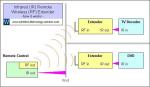 A Remote Control Extender lets you control a projector in a large hall or operate home theatre or TV equipment hidden in a cupboard or another room.